Q4 2025 Digital Ad Rate Trends: Insights to Maximize Your Year-End Campaigns

As we move into Q4, marketers face a pivotal moment; this isn’t just “the season of sales,” it’s the season of?decisive impact. After the momentum built in Q3, consumers are gearing up for final?year decisions, including gift shopping, subscription renewals, year?end upgrades, and more. Digital ad landscapes are shifting accordingly — costs, click rates, and engagement behaviors are evolving fast. 

Here is how Q4 is shaping up to be for us: 

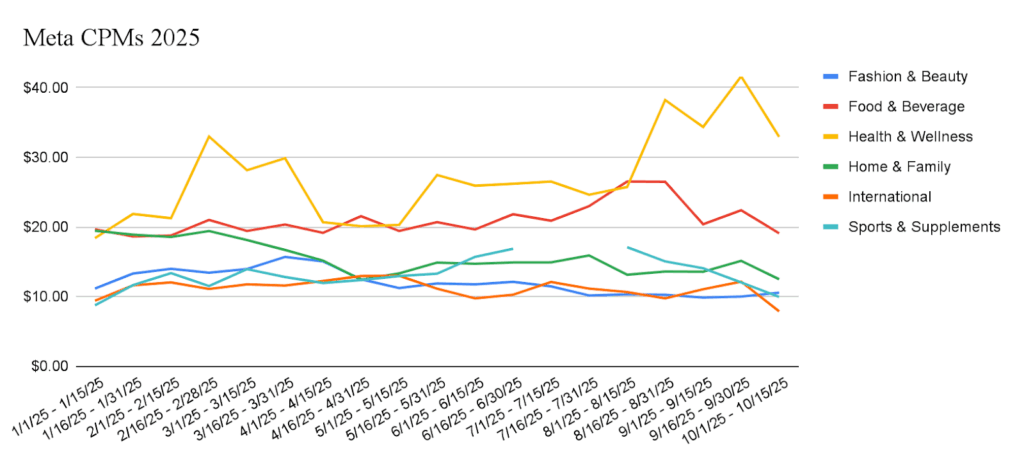
Mid October 2025 (1st-15th)

Meta CPM 

Key Takeaways: 

  • CPMs decreased by 12% during the first half of October 
  • A significant decrease of 21% came from the Health & Wellness vertical 
  • The only vertical to remain stable during this period was Fashion & Beauty.

Meta CPCs
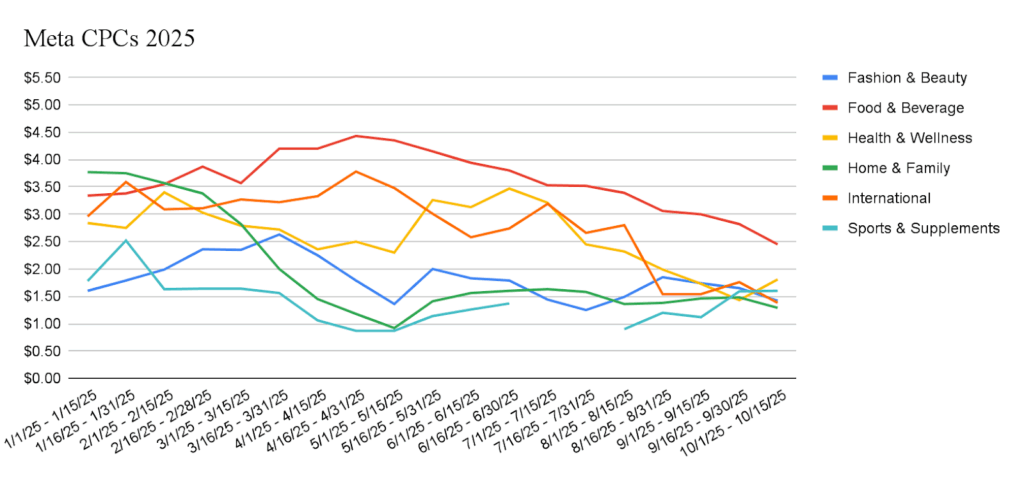
Key Takeaways: 

  • Analysts noticed a 15% decrease in CPCs during this period
  • Fashion & Beauty saw the largest drop of 17% in CPCs
  • A 27% increase was noted within the health & Wellness vertical. 

Meta CTRs
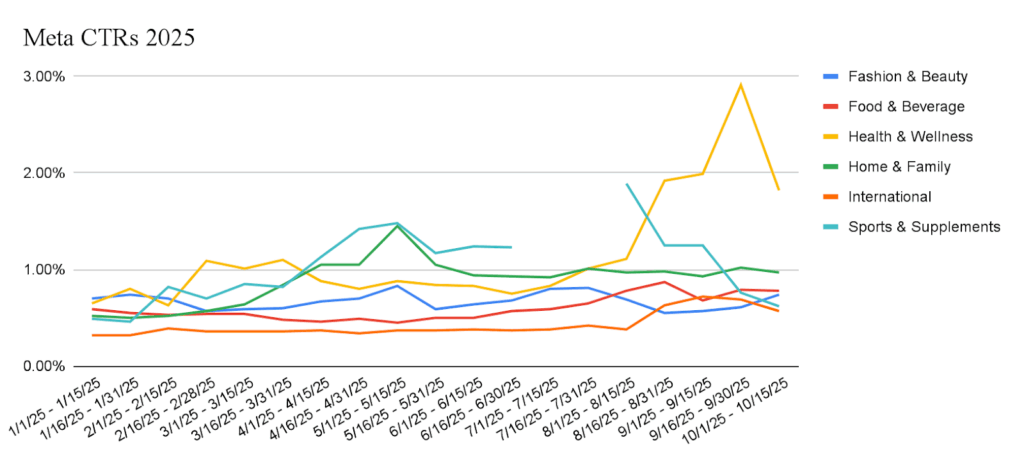
Key Takeaways: 

  • A slight 1% increase in CTRs at  the beginning of October
  • The biggest increase — 21% — was within the Fashion & Beauty vertical 
  • The Health & Wellness vertical saw a 37% drop in CTRs during this period. . 

End-October 2025 (16th-31st) 

Meta CPMs
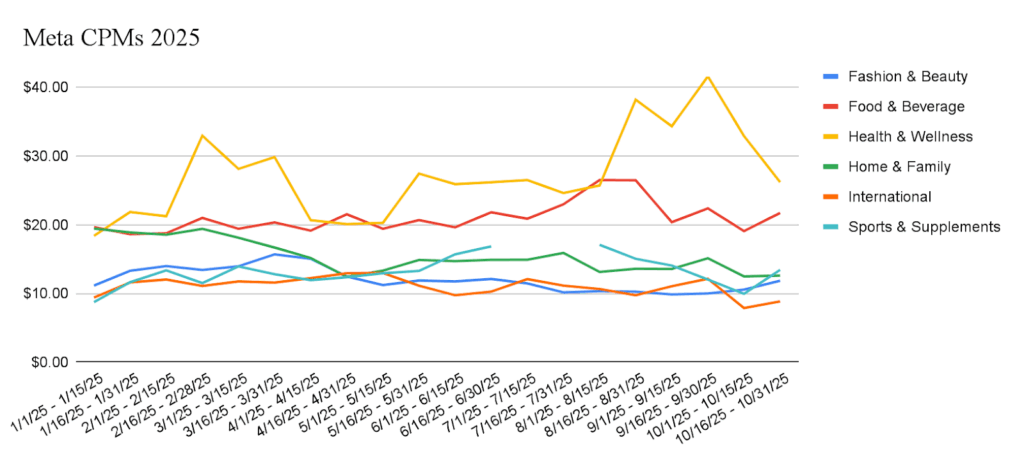
Key Takeaways: 

  • Our analysts noticed a 7% increase in CPMs during this period
  • A significant decrease of 20% was seen in the Health & Wellness vertical 
  • The Sports & Supplements vertical encountered the biggest increase in CPMs, at35%. 

Meta CPCs
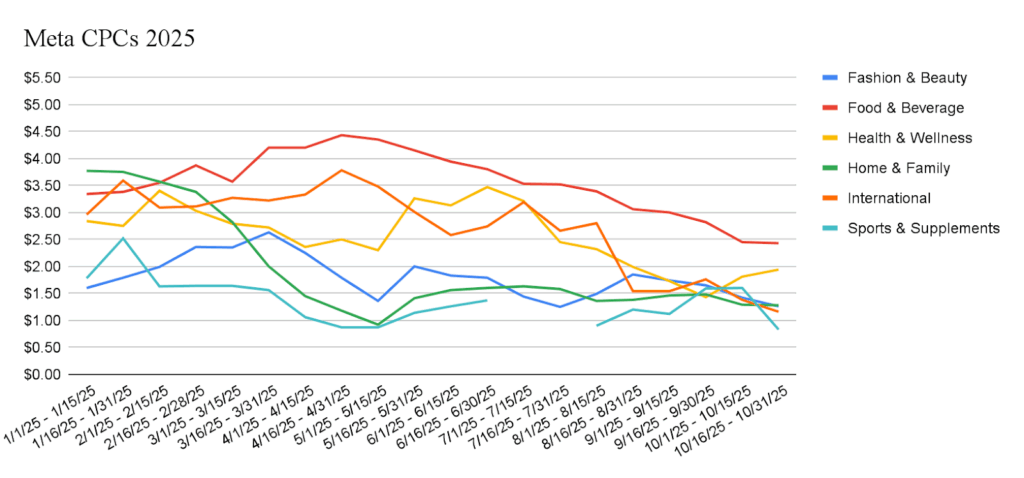
Key Takeaways: 

  • Our analysts noticed a 14% decrease in CPCs during this period
  • The Sports & Supplements vertical saw the largest drop in CPCs at 48% 
  • The Health & Wellness vertical saw a 7% increase in CPCs. 

Meta CTRs
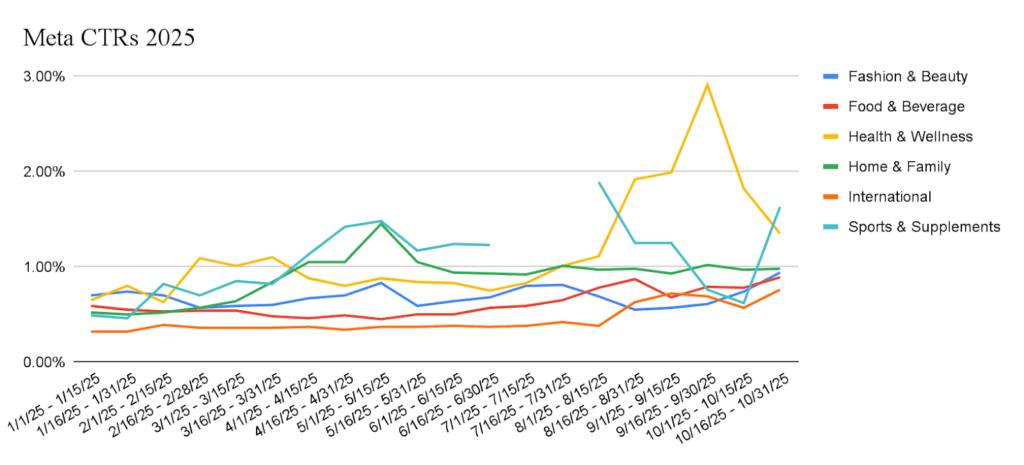
Key Takeaways: 

  • CTRs increased by 19% during the second half of October 
  • A significant increase of 163% was seen within the Sports & Supplements vertical
  • Whereas the Health & Wellness vertical experienced a drop of 26%.. 

Here’s what Senior Growth Analyst, Matthew Whitaker, has to say about these shifts. 

CPMs and CTRs rose while CPCs dropped in the second half of October. Black Friday/Cyber Monday are here! Your content/creative assets should be ready, but make sure to have any last-minute changes completed if needed!” 

Mid November 2025 (1st-15th)

Meta CPMs
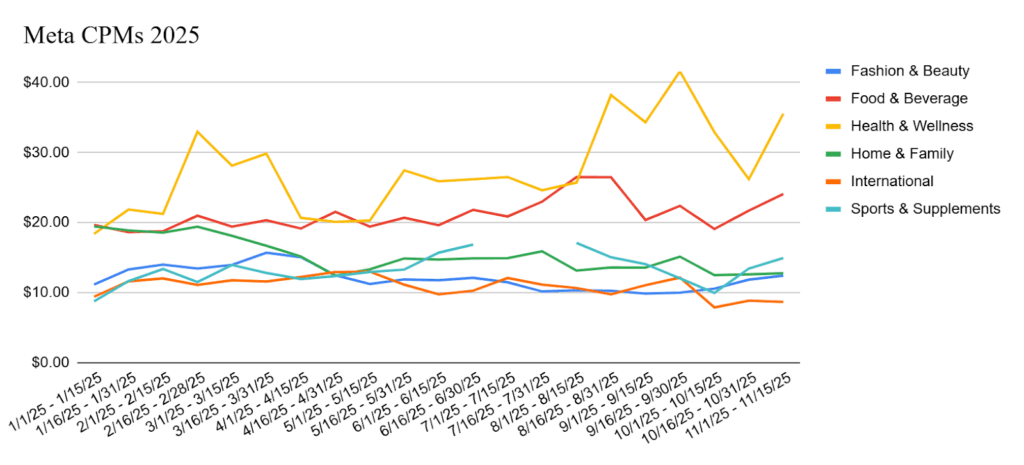
Key Takeaways:

  • CPMs rose by 3% at the beginning of November
  • The International vertical was the only one to experience a rate decrease, falling by 2%
  • The Health & Wellness vertical encountered the biggest increase, rising 36%. 

Meta CPCs
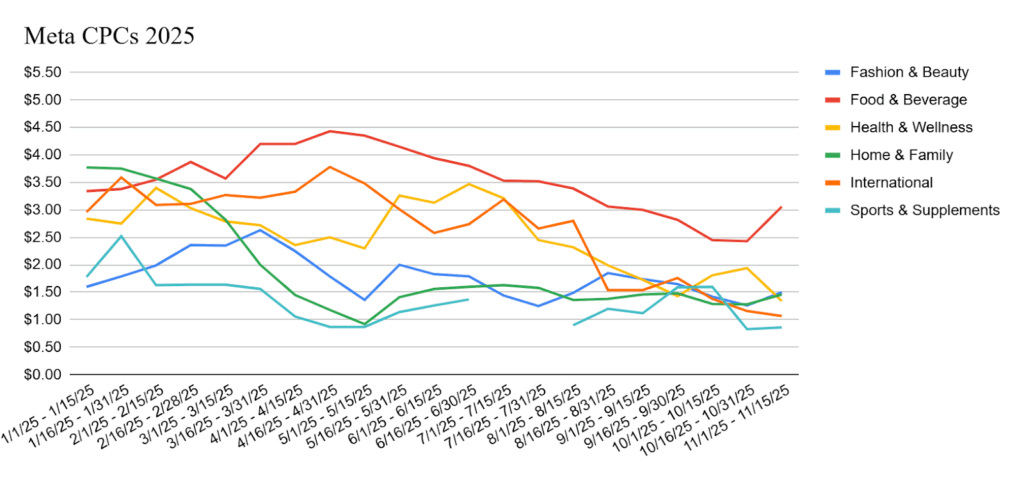
Key Takeaways:

  • CPCs increased by 2% increase during this period 
  • The Health & Wellness vertical experienced a drop of 31% 
  • Whereas the Fashion & Beauty vertical had a 26% increase in CPCs. 

Meta CTRs
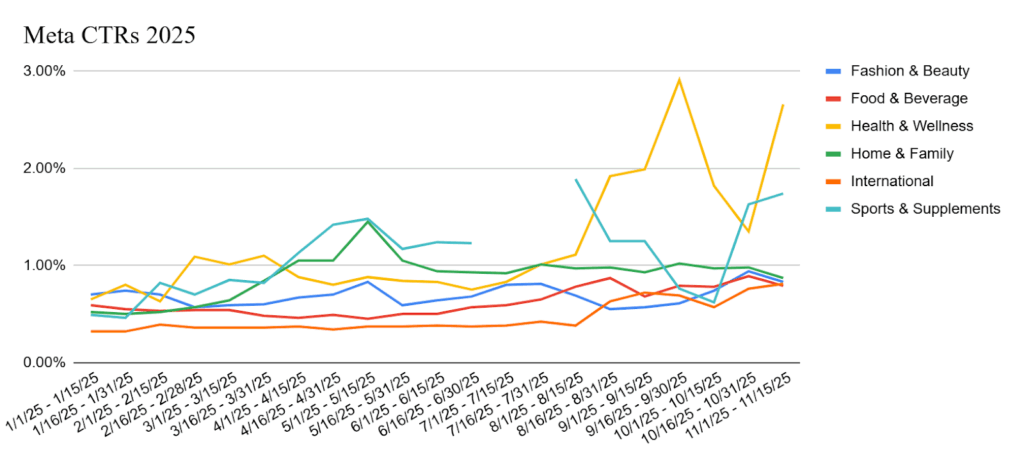
Key Takeaways:

  • According to our analysts, CTRs remained stable during the first half of November
  • A surge of 97% came from the Health & Wellness vertical 
  • The Fashion & Beauty vertical experienced  a minor decrease of 12%.

According to Senior Analyst Matthew Whitaker, here’s what we need to keep in mind for the rest of the month: 

“Black Friday/Cyber Monday is here! Keep a close eye on daily spend/conversions and ensure there are eyes on accounts during the Thanksgiving break. Communicate with clients about additional holiday sales after Cyber Monday. Additionally, confirm any Christmas shipping cutoff dates.”

End November 2025 (16th – 30th) 

Meta CPMs 
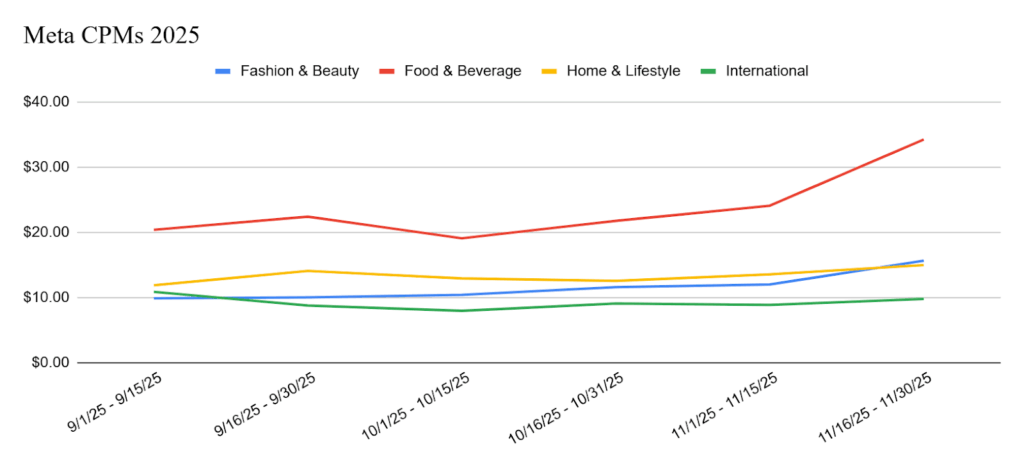
Key Takeaways: 

  • CPMs increased by 11% in the second half of November 
  • The Food & Beverage vertical saw the largest increase, at 42%. 

Meta CPCs 
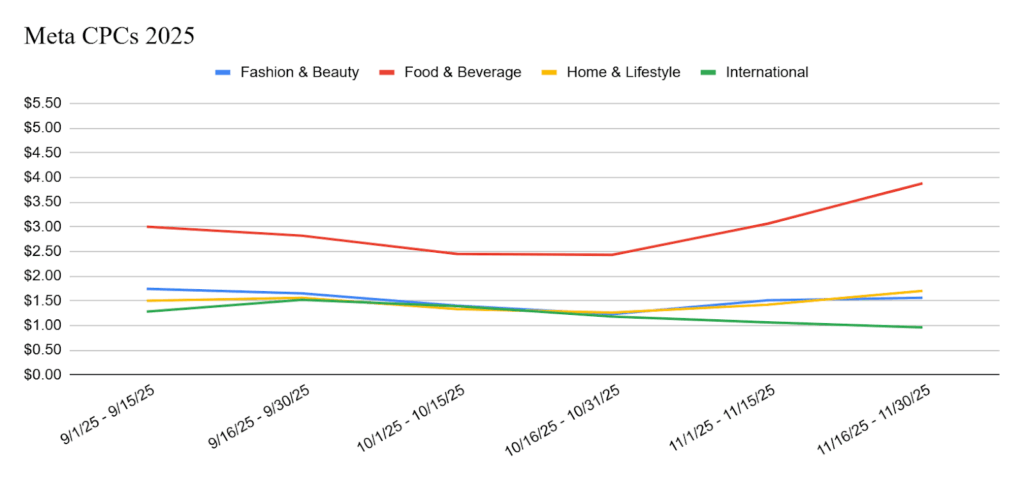
Key Takeaways: 

  • Our analysts noticed a 3% decrease in CPCs during this time period
  • CPCs dropped 9% in the International vertical 
  • The Food & beverage vertical saw the largest increase in CPCs, at 27%.

Meta CTRs
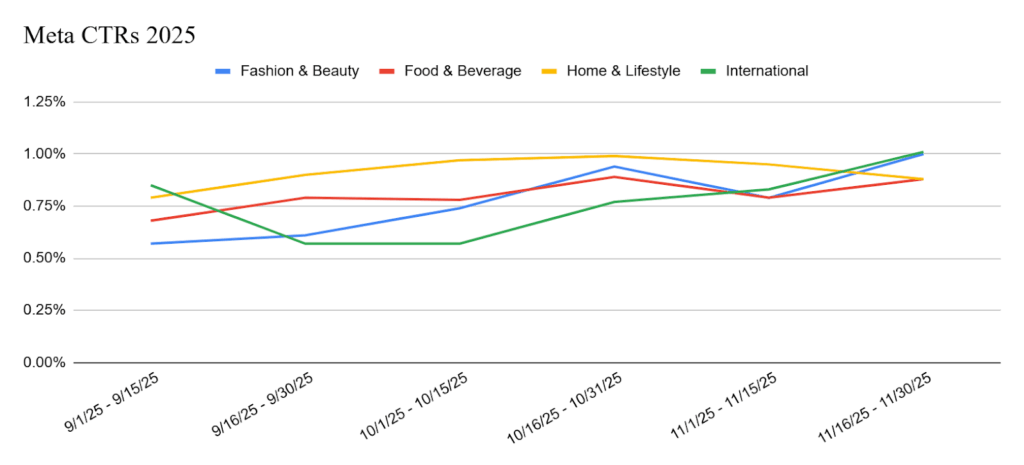
Key Takeaways: 

  • CTRs increased by 14% across the board at the end of November 
  • The Fashion & Beauty vertical saw a significant  27% increase in CTRs
  • Whereas the Home & Lifestyle vertical saw a 7% drop.

Mid-December 2025 (1st – 15th) 

Meta CPMs
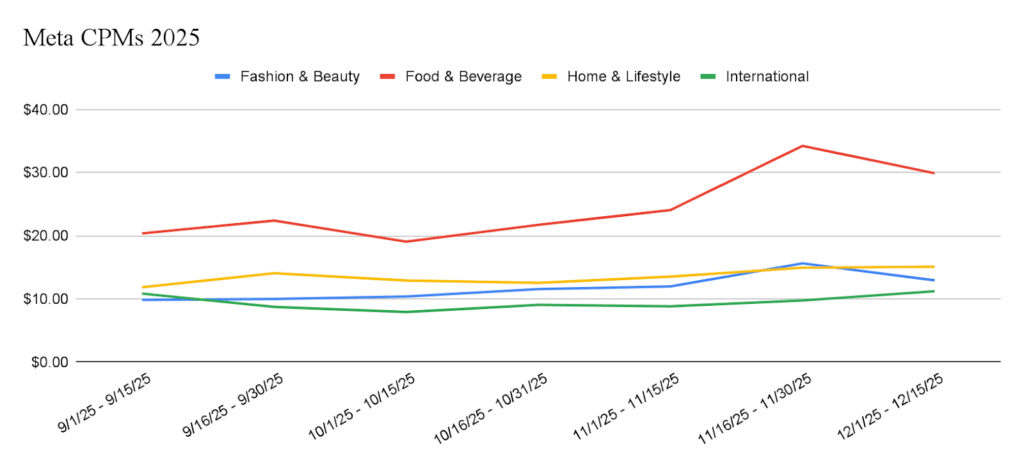
Key Takeaways: 

  • Our analysts noted  an 11% increase in CPMs at the beginning of December 
  • A 15% increase in CPMs was seen in the  International vertical
  • The Fashion & Beauty vertical encountered a 17% drop in CPMs.

Meta CPCs
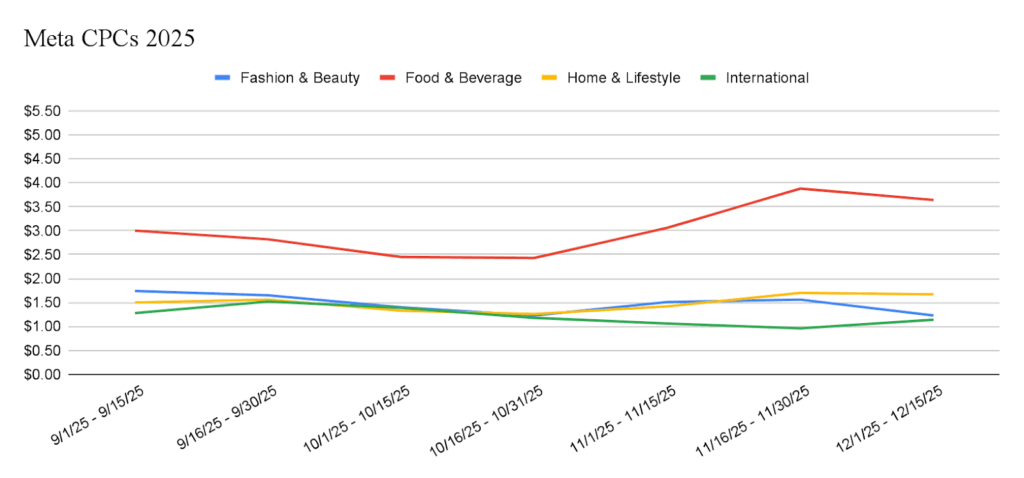
Key Takeaways: 

  • CPCs increased by10% increase during this period 
  • The International vertical experienced the largest rise at 19%
  • The largest decrease, 21%, was in the Fashion & Beauty vertical. 

Meta CTRs
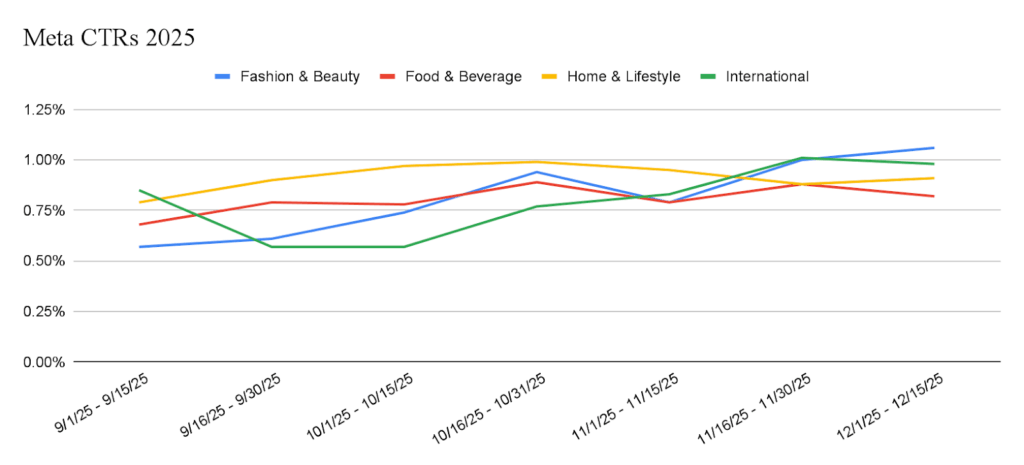
Key Takeaways: 

  • There was a minor 1% increase in CTRs during this period
  • The Fashion & Beauty vertical experienced a 6% jump in CTRs
  • Whereas the Food & Beverage vertical had a 7% decrease in CTRs.

End December 2025 (16th – 31st) 

Meta CPMs
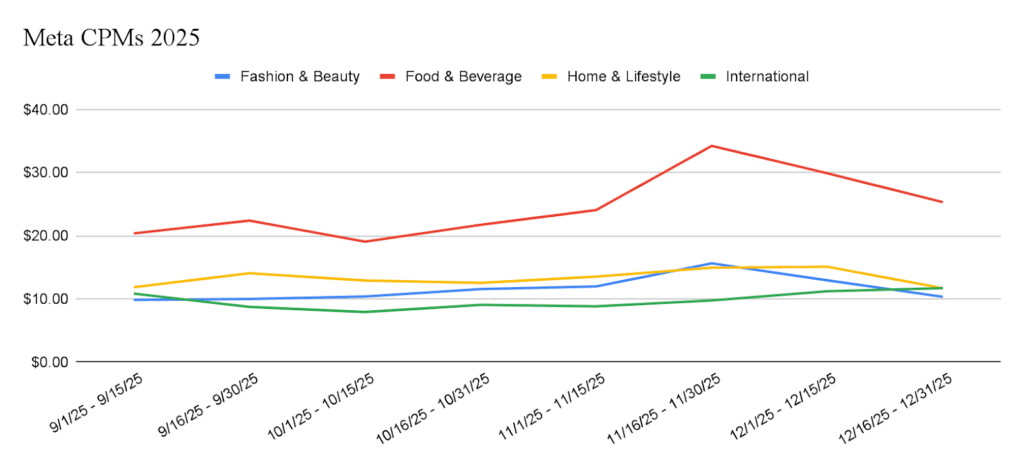
Key Takeaways: 

  • By the end of December,  CPMs had decreased by 10%
  • The largest increase (4%) came from the International vertical, while the Home & Lifestyle vertical saw the largest decrease (23%).

Meta CPCs 
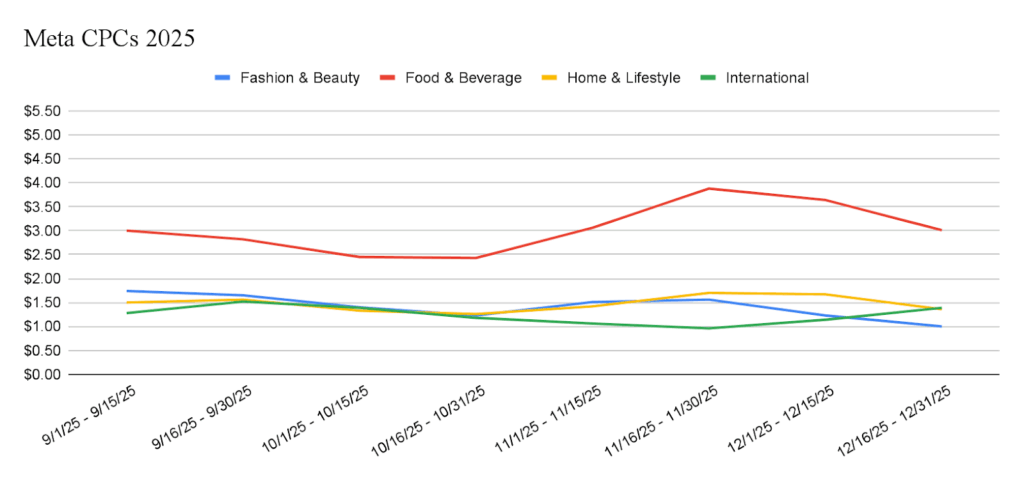
Key Takeaways: 

  • CPCs were stable during this time 
  • The International vertical saw the largest CPC increase at 22% 
  • CPCs in the Fashion & Beauty vertical decreased by 19%. 

Meta CTRs 
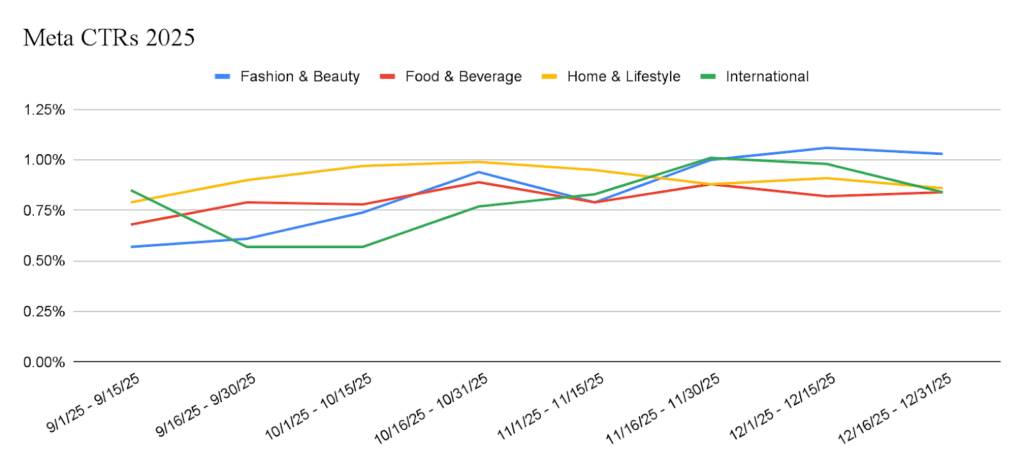
Key Takeaways: 

  • CTRs decreased by 9% during the second half of December 
  • The Food & Beverage vertical saw a 2% increase 
  • The International vertical recorded the largest decrease at 14%.

How GeistM can help 

At GeistM, we’re not just observers of the ad platform landscape — we’re active navigators. As Q4 unfolds, our team is closely tracking evolving metrics across CPMs, CPCs, CTRs, and conversion flows, platform by platform, vertical by vertical. 

With our real-time intelligence, we translate those trends into actionable campaign pivots: optimizing budget allocation, creative refresh timing, and targeting refinements so you stay ahead of seasonal shifts rather than playing catch-up. 

If you’re looking to turn the late-year rush into strategic wins instead of reactive spending, we’re ready to help you make it happen. So contact us today! 

With insights from Matthew Whitaker

How to Avoid Content Fatigue and Keep Your Marketing Campaigns Fresh

In a world where consumers are exposed to thousands of messages every day, content fatigue has become a real challenge for marketers. Content fatigue happens when your audience grows tired of repetitive or uninspired messaging, leading to lower engagement, fewer clicks, and declining conversions.

Keeping your marketing campaigns fresh isn’t just a nice-to-have — it’s essential for standing out in a crowded digital landscape. Brands that can consistently deliver innovative, relevant, and engaging content will build stronger connections and drive lasting impact.

3 Warning Signs of Content Fatigue

Before you can fix it, you need to spot it. Common signs of content fatigue include:

  • Decreasing engagement and response rates – Fewer likes, shares, or comments over time.
  • Audience disengagement or boredom – Loyal followers stop interacting, and new audiences don’t stick around.
  • Stagnation in performance metrics – CTRs, conversions, and ROI plateau or decline despite steady effort.

4 Strategies to Prevent Content Fatigue

1. Diversify Content Formats

One of the fastest ways to fight fatigue is to switch up how you deliver your message. Different formats appeal to different audience preferences, and variety keeps content fresh.

  • Video content (short-form reels, tutorials, behind-the-scenes looks) is highly engaging and continues to dominate social platforms.
  • Blog posts and long-form articles not only build authority but also educate readers.
  • Infographics simplify complex information and are highly shareable.
  • Interactive content — such as polls, quizzes, anchor links, and accordion links encourages participation rather than passive consumption.

By mixing formats, you ensure your campaigns remain dynamic and adaptable across multiple channels.

2. Repurpose and Refresh Old Content

Creating new content from scratch takes significant time and resources. Instead, look at your top-performing assets and find ways to breathe new life into them:

  • Update statistics, visuals, and examples in older articles to make them current.
  • Optimize articles by adding more rich media elements
  • Reformat: Turn a whitepaper into a carousel post, a webinar into a highlight reel, or a blog into an email nurture sequence.

Repurposing ensures your best content continues to deliver ROI while keeping your content library fresh.

3. Leverage User-Generated Content (UGC)

Modern consumers crave authenticity, and nothing feels more authentic than UGC. Encouraging customers to share reviews, testimonials, unboxing videos, or social media posts provides fresh material that feels genuine.

UGC not only rejuvenates your content calendar but also builds trust. According to recent studies, consumers are significantly more likely to trust peer recommendations than branded messaging. UGC also strengthens community engagement, making audiences feel like active participants in your brand story.

4. Implement Seasonal & Timely Themes

Relevance is a critical driver of freshness. Aligning campaigns with holidays, seasonal shifts, cultural events, and industry trends ensures your messaging feels current.

  • Update statistics, visuals, and examples in older articles to make them current.
  • Optimize articles by adding more rich media elements.
  • Reformat: Turn a whitepaper into a carousel post, a webinar into a highlight reel, or a blog into an email nurture sequence.

This strategy not only prevents monotony but also creates urgency, prompting audiences to engage right now.

Engage Your Audience with Personalization in Paid Campaigns

When running paid campaigns, generic ads won’t cut it. With the advanced targeting capabilities available, audiences expect brands to deliver ads that feel relevant to their unique needs and interests. Personalization is no longer optional — it’s the key to preventing content fatigue in performance marketing.

  • Data-driven targeting – Paid platforms like Meta, Google, TikTok, and programmatic networks allow marketers to use demographic data, behavioral signals, and purchase intent to serve ads to the right audience at the right time. This ensures your budget is spent efficiently while delivering relevance.
  • Audience segmentation – Break down your paid campaigns into tailored segments — whether it’s new prospects, high-value customers, or cart abandoners. Each group should see creative and messaging that speaks directly to their journey stage and motivations.
  • Dynamic ad creative – Platforms now support dynamic content insertion, enabling personalized ad experiences at scale. From customized product recommendations to location-specific offers, this approach boosts CTRs and keeps campaigns fresh.
  • Retargeting strategies – Personalized retargeting campaigns remind users of products they browsed, highlight limited-time deals, or share tailored upsell opportunities, all while reducing ad fatigue by staying relevant.

By leveraging these personalized paid campaign strategies, brands can cut through the noise, reduce wasted impressions, and create meaningful touchpoints that drive conversions.

Track Performance and Iterate

Even the most innovative campaigns will eventually plateau if they aren’t optimized. To keep your marketing efforts fresh and avoid content fatigue, continuous performance tracking and iteration are essential. The key is to move beyond a “set it and forget it” mentality and embrace a data-driven approach where campaigns are consistently monitored, tested, and refined.

  • Monitor the right metrics – Engagement metrics like click-through rates (CTR), conversion rates, time on page, bounce rates, and cost per acquisition (CPA) reveal how your content is resonating with audiences. For paid campaigns, also track frequency (how often the same user sees your ads) to avoid oversaturation — a leading cause of ad fatigue.
  • A/B and multivariate testing – Experiment with variations in subject lines, headlines, visuals, CTAs, and landing page layouts. Even minor tweaks — like adjusting ad copy length or testing two versions of a product image — can significantly improve performance. Multivariate testing allows you to optimize multiple elements at once to find the best-performing combination.
  • Leverage advanced analytics tools – Platforms like Google Analytics 4, Meta Ads Manager, TikTok Ads Manager, and programmatic DSP dashboards provide granular insights into how audiences interact with your campaigns. By analyzing cross-channel performance, you can see which platforms, formats, and targeting strategies deliver the strongest ROI.
  • Optimize in real timeMarketing in 2025 requires agility. If engagement drops, pivot quickly by refreshing creative, testing new audience segments, or adjusting bid strategies. Iteration is not just about fixing what doesn’t work but also about amplifying what does.
  • Learn from patterns over time – Tracking performance across multiple campaigns reveals trends in audience behavior. For example, you may find that video ads consistently outperform static images or that certain audience segments engage more during specific times of year. These insights help guide future campaign planning and prevent stagnation.

By making performance monitoring and iteration a continuous cycle, marketers can adapt to changing consumer behaviors, reduce wasted ad spend, and keep campaigns consistently fresh and effective. Ultimately, iteration is what transforms one-off creative ideas into long-term, scalable growth strategies.

Collaborate with Agencies & Third-Party Creators

Sometimes the most effective way to refresh your marketing is by stepping outside of your own brand bubble. Partnering with agencies and third-party creators injects fresh perspectives, ensures constant content variety, and helps prevent campaigns from going stale.

At GeistM, we’ve built this approach into our model:

  • Third-party publishing power – GeistM owns a network of publisher sites where we can host long-form articles, listicles, and reviews about your brand. Instead of relying solely on brand-owned channels, campaigns can run through trusted third-party handles, adding credibility and building consumer trust in ways direct brand ads often can’t.
  • In-house creative expertise – Our team of creators, content strategists, and data analysts produces a full spectrum of assets tailored to your brand. From longform articles to UGC-style videos for paid campaigns, we handle concepting, production, and ongoing optimization to ensure your content resonates across formats.
  • Continuous refresh and testing – Content isn’t static. We regularly refresh, split test, and iterate to keep messaging sharp and performance strong. This data-driven process helps prevent fatigue by ensuring audiences don’t see the same stale ads over and over.
  • Personalized audience experiences – With our ability to craft content for different audience segments, we add a personal touch while still maintaining the authority of a third-party perspective. By distributing through our publishers and paid channels, we put the right content in front of the right audience at the right time.

Collaborating with GeistM doesn’t just provide new content — it gives you an entire ecosystem of publishers, expert creators, and analysts working to keep your campaigns fresh, trustworthy, and continuously optimized for maximum engagement.

The most successful brands will be those that embrace adaptability — refreshing strategies, testing new approaches, and evolving alongside their audiences to maintain lasting engagement.

If your brand is ready to fight content fatigue and keep campaigns performing at their peak, GeistM can help you stay ahead of the curve.

Written by: Emma McHugh

Retention vs. Acquisition: Where Should Your Marketing Dollars Go?

Marketing has its own version of a “Chicken or the Egg” problem. Which comes first, finding new customers, or nurturing the ones you already have?

Every business leader faces this same question, and the answer isn’t always obvious. While both are essential for a healthy business, the specific balance of your investment can dramatically change your trajectory.

We’re going to break down this great debate, help you understand the pros and cons of each, and show you how to find the right blend for your brand. 

What is New Customer Acquisition?

New Customer Acquisition is the process of getting new customers to try your product or service for the first time. It’s all about making a great first impression and getting them to commit.

  • Common Channels: Acquisition is powered by strategies such as paid ads on platforms like Meta, Taboola, and Google, as well as influencer marketing and SEO, which put you at the top of search results.
  • Pros: Acquisition is the engine of growth. It’s how you scale your business, enter new markets, and expand your reach. It provides a steady stream of new revenue and keeps your business from becoming stagnant.
  • Cons: It’s expensive to do right. The cost for a new customer is significantly higher than the cost of retaining existing ones.
  • Pro Tip: Acquisition can be a high-effort, low-yield game. It requires constant testing and optimisation to find the right people at the right time. Don’t be afraid to pull the plug on underperforming campaigns to focus your budget on what’s working.

What is Customer Retention?

Customer Retention is the practice of keeping the customers you already have. This is where the long-term relationship building happens. It’s about turning a single purchase into a second, a third, a fourth, and a lifetime of loyalty. The goal isn’t just about building a customer list but about cultivating a loyal brand community.

  • Common Channels: Retention strategies involve the use of powerful campaigns driven through email, SMS, and app push channels, alongside a healthy mix of paid media campaigns on social media such as Meta, X, and Reddit, not to mention your customer service.
  • Pros: Retention is often more cost-effective. Happy retained customers are not only a source of stable revenue, but also your best brand advocates. They’ll tell their friends, leave positive reviews, and organically drive new customers for you. Their Customer Lifetime Value (LTV) can be HUGE.
  • Cons: You can’t scale a business on retention alone; you still need a steady stream of new customers to fuel the first. Focusing too much on retention can also lead to a static customer base, limiting your total growth.
  • Pro Tip: Retention is not a passive game! You have to engage with your customer base and add value actively. Do it right? Your customers become your brand ambassadors, converting their friends and family. Do it wrong? They’ll run away faster and further.

Metrics that Matter: The numbers behind the decisions.

To make data-driven decisions, you need to understand these core metrics. 

  • Customer Acquisition Cost (CAC): The total cost of sales and marketing needed to acquire a single customer.
  • Customer Lifetime Value (LTV): The total revenue a single customer is expected to generate over their entire relationship with you.
  • Conversion Rate: The percentage of visitors to your site that end up doing what you want them to do.
  • Retention Rate: The percentage of customers you’ve kept over a specific period.
  • Churn Rate: The percentage of customers who stop doing business with you over a specific period.
  • Pro Tip: Your LTV should ALWAYS be higher than your CAC. This is the golden rule of profitability. If you’re spending more to get a customer than they’ll ever spend with you, then you’re going to have a bad time!

When to Focus on Acquisition 

There are clear phases in a business’s life cycle where acquisition should be the primary focus.

  • Early Stage Startups or New Product Launches: When you’re just starting out, you have no customers to retain. Your number one priority is to introduce your brand, product, or service to the world and establish your customer base.
  • Entering New Markets: If you’re an established business already and are expanding into a new country or demographic, you’re essentially a startup again. An aggressive acquisition strategy is key to building your new customer base.
  • Growth Mode: When you have a proven market fit product and a healthy LTV, it’s time to pour some petrol on the fire and get things moving. An aggressive acquisition strategy, powered by high-performing paid ads and organic channels, can help you scale quickly.

When to Focus on Retention

While acquisition is the growth engine, retention is the stability and long-term profitability that keeps the engine running smoothly. 

  • Established Customer Base: If you’ve been in business for a while, it’s often more efficient to invest in nurturing your existing customers than constantly chasing new ones.
  • High Acquisition Cost Market: In highly competitive markets, or where a market is just overly saturated, a strong retention strategy is crucial to maximising the LTV of each customer.
  • Subscription-Based Model: For companies that rely on subscription-based revenue, retention is a matter of survival. Every customer you lose is a direct hit to your bottom line, making retention strategies a top priority.
  • New Product Launches to Existing Customers: Sometimes, retention can drive acquisition. Cross-selling a new product to your existing customer base is one of the most efficient ways to launch something smoothly. Especially if this customer base already loves and trusts you!

Finding the Sweet Spot: How to Split Your Budget

Finding the perfect split isn’t an exact science; it’s a dynamic process of analysis and adjustment. 

  • Know Your Metrics: Start by looking at your data. What is your current CAC vs LTV? What is your churn rate? Why did that customer abandon their cart 17 times at 3:11 am on Sunday? The answers to these questions will reveal where you’re strong, and where you’re bleeding money.
  • Know Your Objectives: If your goal is aggressive market share growth, a heavier acquisition budget might make more sense. If your goal is sustainability, a more balanced approach could be better.
  • Build Your Feedback Loop: Your retention strategy should inform your acquisition strategy. By understanding why your most loyal customers are here, you can build better audiences for your acquisition campaigns, finding more people just like them!
  • Pro Tip: The best strategies are never static. The ratio of your budget allocations should change as your business and objectives evolve. What works for a startup won’t work for a mature company, and vice versa. Continually test and refine your budget split to match your current needs!

Why GeistM is the Perfect Partner

This isn’t a “chicken or the egg” question; it’s a “how and when” question. And that’s where a partner like GeistM becomes invaluable. We don’t believe in a one-size-fits-all approach; we believe in a holistic, data-driven strategy that makes every dollar and cent count. 

  • Holistic Strategy: We understand that acquisition and retention are two sides of the same coin. We build comprehensive strategies that integrate both, ensuring everything is balanced and effective across the entire customer journey.
  • Data-Driven Decisions: Our team of experts meticulously analyzes the CAC, LTV, and other key metrics to make informed decisions about allocations. We’ll never blindly throw money at a campaign hoping for the best. Everything we do is backed by a metric that matters.
  • The Perfect Partner: GeistM is the perfect partner for this because we don’t force you into one camp. We are flexible, agile, and capable of building custom strategies that perfectly match your business’s needs, whether that’s aggressive growth, sustainability, or a mix of both.
  • Pro Tip: The best strategies are never static. The ratio of your budget allocations should change as your business and objectives evolve. What works for a startup won’t work for a mature company, and vice versa. Continually test and refine your budget split to match your current needs!


The battle between retention and acquisition isn’t a battle at all. It’s a dance. And with the right partner, you can master the steps and build a brand that not only grows fast, but also lasts. So contact GeistM today, and we’ll take care of everything for you!

Written by: Conor Dargle

7 Key Skills That Make You a Proficient Digital Marketer

In today’s digital age, effective marketing strategies can make or break a business. With the vast online landscape and ever-evolving consumer behaviors, businesses must have proficient digital marketers on board. These skilled professionals possess unique abilities that enable them to successfully navigate the complexities of the digital world. 

With many corporations implementing digital marketing practices and hiring experts, let’s look at the top skills required:

1. Data Analysis and Insights

One of the fundamental skills is the ability to analyze data effectively. Digital marketing is highly data-driven, and understanding key metrics and insights can significantly impact a campaign’s success. 

An adept digital marketer can interpret data from various sources, such as website analytics, social media platforms, and advertising campaigns. By leveraging these insights, they make data-backed decisions, optimize campaigns, and identify new growth opportunities. This removes the guesswork in your marketing strategy and ensures that you generate optimal value from your marketing budget.

2. Strategic Thinking and Planning

Successful digital marketers possess strategic thinking and planning skills. They can develop a comprehensive strategy aligned with your business objectives. These professionals assess your target audience, competition, and industry trends and create roadmaps that maximize your online presence. 

A proficient marketer will consider factors like content marketing, search engine optimization (SEO), social media, email marketing, and paid advertising to develop a cohesive and effective marketing plan that drives conversions and pushes your business forward.

3. Writing & Editing

This just may be the most crucial element because content marketing is still king. Digital marketers need to understand how to source and write compelling content that makes for excellent blog posts. They also need to turn a weak piece of content into one that truly catches your audience’s attention

A great marketer has exceptional content creation and storytelling skills that captivate audiences and build brand awareness. They create relevant and convincing content tailored to different digital platforms and compose impactful messages that establish trust and build relationships.

4. Search Engine Optimization (SEO) 

Comprehending the intricacies of search engine optimization (SEO) is essential so your website and content rank higher in search engine results. Implementing effective SEO strategies can increase your website’s visibility, improve organic traffic, and generate valuable leads.

Digital marketing experts are skilled in keyword research, on-page optimization, link building, and technical SEO aspects. They’re aware that Google’s algorithm is constantly changing, and that they need to look out for what’s trending to ensure your content reaches the ideal target audience.

5. Conversion Rate Optimization 

The goal of every marketing campaign is to drive traffic to a site and capture customers. Conversion rate optimization involves testing various web pages, content pieces, calls-to-action, ads, and more to see what converts the best. 

Digital marketers have to run intelligent A/B tests, gain data and make the necessary strategic adjustments to increase revenue per visitor, acquire customers, and continuously grow your business.

6. Graphic Design & Video 

Much of today’s marketing world is driven by visuals. Content across a variety of platforms performs better when accompanied by thoughtfully designed graphics. If you want to target your audience with high-performance ads, you should create and edit your own visuals – from banner ads, email banners, and logos to short videos with and without voiceovers. 

We all know that videos are taking over the internet due to their higher engagements, conversion rates, and SEO rankings. Many programs – Photoshop, Illustrator, Premiere Rush, and more – can help you create excellent visual content. 

7. Continuous Learning and Adaptability

The digital landscape is ever-changing, with new technologies, platforms, and trends emerging daily. A proficient digital marketer is hungry for knowledge and committed to continuous learning. They keep up-to-date with industry trends, algorithm shifts, and evolving consumer behavior

By keeping their skills sharp, digital marketers deftly adapt and form innovative strategies that ensure your business remains ahead of the curve. Some ways to do this are maintaining online certifications (Google Analytics Excel, Adobe, etc), following the latest industry news from reputable sources (Ad Age, Mashable, etc), and attending webinar training sessions through networking sites like LinkedIn. 

Becoming a proficient digital marketer requires a diverse skill set and a deep understanding of the digital landscape. By mastering data analysis, strategic thinking, content creation, SEO, and adaptability, you can take your efforts to new heights. However, navigating the complexities of digital marketing can be challenging if you don’t have access to the right expertise. That’s where our digital marketing agency comes into play. 

At GeistM, we pride ourselves on possessing all the essential skills for proficient digital marketing. Our team comprises data-driven analysts, strategic thinkers, creative content creators, SEO experts, and adaptive professionals. We combine our expertise and experience to create tailored digital marketing solutions for diverse clients from various industries, to drive tangible results for your business. Contact us today!